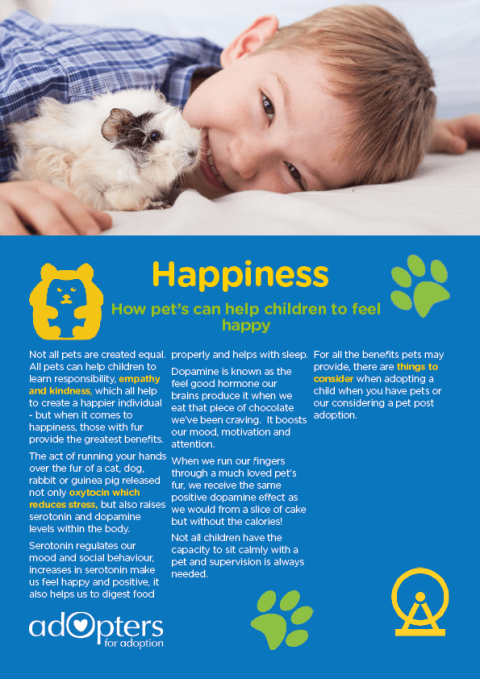
Not all pets are created equal. All pets can help children to learn responsibility, empathy and kindness, which all help to create a happier individual – but when it comes to happiness, those with fur provide the greatest benefits.
The act of running your hands over the fur of a cat, dog, rabbit or guinea pig released not only oxytocin which reduces stress, but also raises serotonin and dopamine levels within the body.
Serotonin regulates our mood and social behaviour, increases in serotonin make us feel happy and positive, it also helps us to digest food properly and helps with sleep.
Dopamine is known as the feel good hormone our brains produce it when we eat that piece of chocolate we’ve been craving. It boosts our mood, motivation and attention.
When we run our fingers through a much loved pet’s fur, we receive the same positive dopamine effect as we would from a slice of cake but without the calories!
Not all children have the capacity to sit calmly with a pet and supervision is always needed.
We all know that stroking a pet feels nice, but did you know that it’s scientifically proven to feel good?
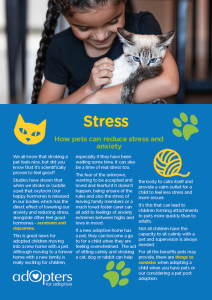
Studies have shown that when we stroke or cuddle a pet that oxytocin (our happy hormone) is released in our bodies which has the direct effect of lowering our anxiety and reducing stress, alongside other feel good hormones – serotonin and dopamine.
This is great news for adopted children moving into a new home with a pet. Although moving to a forever home with a new family is really exciting for children, especially if they have been waiting some time, it can also be a time of real stress too.
The fear of the unknown, wanting to be accepted and loved and fearful if it doesn’t happen, being unsure of the rules and also the stress of leaving family members or a much loved foster carer can all add to feelings of anxiety extremes between highs and lows in mood.
If a new adoptive home has a pet, they can become a go to for a child when they are feeling overwhelmed. The act of sitting calmly and stroking a cat, dog or rabbit can help the body to calm itself and provide a calm outlet for a child to feel less stress and more secure.
It’s this that can lead to children forming attachments to pets more quickly than to adults.
Not all children have the capacity to sit calmly with a pet and supervision is always needed.
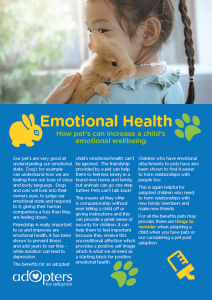
Our pet’s are very good at understanding our emotional state. Dog’s for example can understand how we are feeling from our tone of voice and body language. Dogs and cats will look into their owners eyes, to judge our emotional state and respond to it, giving their human companions a fuss then they are feeling down.
Friendship is really important to us and improves are emotional health, it has been shown to prevent illness and add years to our lives – while isolation can lead to depression.
The benefits for an adopted child’s emotional health can’t be ignored. The friendship provided by a pet can help them to feel less lonely in a brand new home and family, but animals can go one step further. Pets can’t talk back!
This means all they offer is companionship without ever telling a child off or giving instructions and this can provide a great sense of security for children, it can help them to feel important because they receive this unconditional affection which provides a positive self image which is what we all need as a starting block for positive emotional health.
Children who have emotional attachments to pets have also been shown to find it easier to form relationships with people too.
This is again is helpful for adopted children who need to form relationships with new family members and make new friends.
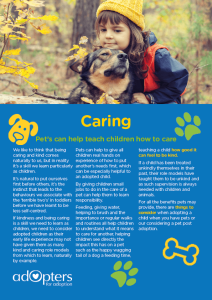
We like to think that being caring and kind comes naturally to us, but in reality it’s a skill we learn particularly as children.
It’s natural to put ourselves first before others, it’s the instinct that leads to the behaviours we associate with the ‘terrible two’s’ in toddlers before we have learnt to be less self-centred.
If kindness and being caring is a skill we need to learn as children, we need to consider adopted children as their early life experience may not have given them as many kind and caring role models from which to learn, naturally by example.
Pets can help to give all children real hands on experience of how to put another’s needs first, which can be especially helpful to an adopted child.
By giving children small jobs to do in the care of a pet can help them to learn responsibility.
Feeding, giving water, helping to brush and the importance or regular walks and routines all help children to understand what it means to care for another, helping children see directly the impact this has on a pet such as the happy wagging tail of a dog a feeding time, teaching a child how good it can feel to be kind.
If a child has been treated unkindly themselves in their past, their role models have taught them to be unkind and as such supervision is always needed with children and animals.
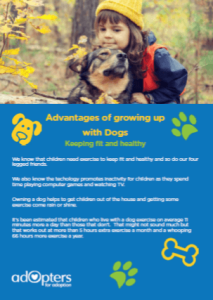
We know that children need exercise to keep fit and healthy and so do our four legged friends.
We also know the technology promotes inactivity for children as they spend time playing computer games and watching TV.
Owning a dog helps to get children out of the house and getting some exercise come rain or shine.
It’s been estimated that children who live with a dog exercise on average 11 minutes more a day than those that don’t. That might not sound much but that works out at more than 5 hours extra exercise a month and a whooping 66 hours more exercise a year.
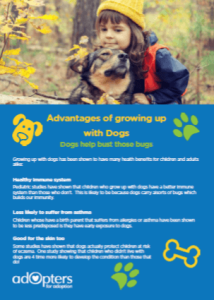
Growing up with dogs has been shown to help humans to bust those bugs leading to many health benefits for children and adults alike:
Healthy immune system
Pediatric studies have shown that children who grow up with dogs have a better immune system than those who don’t. This is likely to be because dogs carry all sorts of bugs which builds our immunity.
Less likely to suffer from asthma
Children whose have a birth parent that suffers from allergies or asthma have been shown to be less predisposed is they have early exposure to dogs.
Good for the skin too
Some studies have shown that dogs actually protect children at risk of eczema. One study showing that children who didn’t live with dogs are 4 time more likely to develop the condition than those that do!
If you have a dog or other pets, here are a few things to consider before you adopt.
For all the benefits pets may provide, there are things to consider when adopting a child when you have pets or our considering a pet post adoption.